
Light Requirements
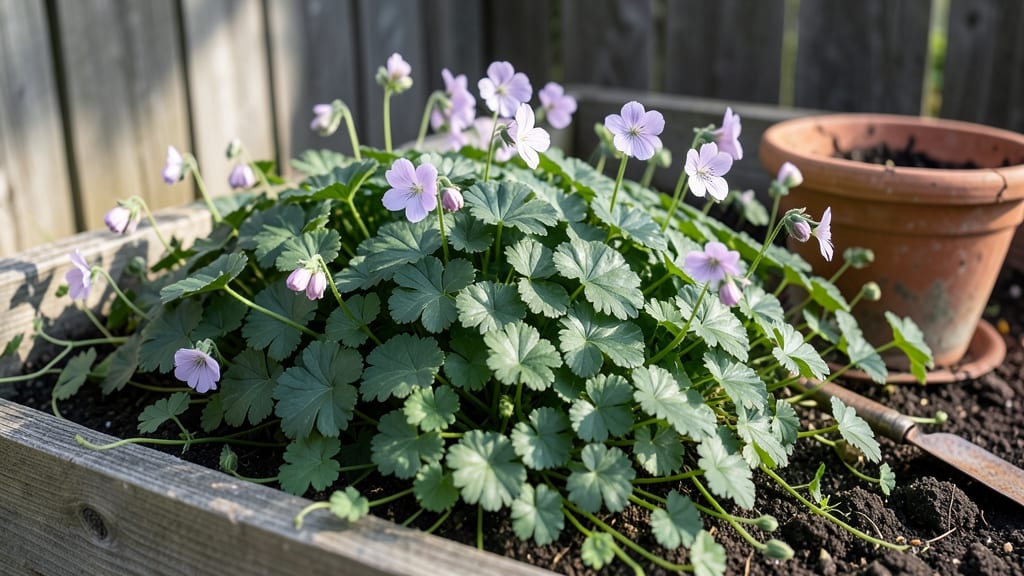
Shade-tolerant geraniums thrive in low-light conditions with varieties like Elizabethan, Johnson’s Blue, and Rozanne, which require well-draining soil, consistent moisture, and occasional pruning to prevent legginess. Avoid soggy soil to prevent root rot in dimmer settings.
These hardy plants adapt to lower light by developing thicker leaves that capture more sunlight, though they’ll still produce fewer blooms than sun-loving varieties. Elizabethan and Johnson’s Blue stand out for their deep purple foliage, which helps them absorb light more efficiently in shady spots. 🌿 While they tolerate partial shade, placing them in morning sun or dappled light will encourage more vibrant flowers and lush growth.
For best results, mix in compost or perlite to improve drainage, especially in containers where moisture can pool. Prune leggy stems in early spring to redirect energy toward bushier growth, and fertilize lightly with a balanced formula every 4-6 weeks during the growing season.
💡 In This Article
- How Light Levels Affect Shade-Tolerant Geranium Growth
- Best Practices for Planting and Maintaining Shade-Loving Geraniums
How light levels affect shade-tolerant geranium growth
Shade-tolerant geraniums adapt to low-light conditions through a fascinating biological process called chlorophyll efficiency optimization. In dimmer settings, these plants produce more chlorophyll b—a pigment that helps capture light in the blue-green spectrum—while maintaining a thicker leaf structure.
This adaptation allows them to absorb up to 30% more light than sun-loving varieties, though their growth rate slows significantly. The trade-off? Their energy is diverted toward leaf development rather than flower production, which is why shade geraniums like Rozanne bloom less prolifically than their sun-happy cousins.
The deep purple foliage of varieties like Elizabethan isn't just for show—it's a survival mechanism. Anthocyanins, the pigments responsible for the rich color, act as natural sunscreens in bright light but also help absorb additional light in shaded areas.
Studies show these pigments can increase light absorption by 15-20% in low-light conditions, giving the plant an edge. However, this pigmentation comes with a cost: the plant must allocate more energy to maintaining these protective compounds, further reducing flower output. 🌿
Photosynthesis in shade geraniums follows a different pathway than sun-loving plants. Instead of relying on direct sunlight, they maximize diffuse light—the scattered light that reaches them through tree canopies or building shadows.
This means their leaves develop a broader surface area to capture more photons, often appearing larger and slightly waxier. The downside? These adaptations make them more vulnerable to moisture stress, as their increased surface area can lead to faster water loss in dry shade.
Compare this to full-sun geraniums, which have thinner, lighter-colored leaves optimized for high-intensity light. Sun varieties can produce 2-3 times more flowers but struggle in shade, where their leaves may turn yellow or develop weak stems. Shade-tolerant types, meanwhile, maintain their structure but with a more compact growth habit.
This is why Johnson’s Blue thrives under 2-4 hours of morning sun—its leaves are better equipped to handle the transition between bright and dim conditions.
Light intensity also affects the plant's internal clock. Shade geraniums enter a semi-dormant state more quickly in winter, conserving energy when light levels drop below 2,000 lux (a measure of light intensity).
This explains why they often go dormant earlier than sun varieties, sometimes as early as late September in cooler climates. Understanding this helps gardeners time their pruning and fertilizing cycles for maximum impact.
For those with east-facing windows or heavily shaded patios, consider the light spectrum. Artificial grow lights emitting 5,000-6,500K color temperature (cool white) can supplement natural light, mimicking the blue-green wavelengths these plants need.
A 12-hour photoperiod with grow lights during winter months can extend the growing season by 4-6 weeks, though it won't replace natural light entirely.
What most gardeners don't realize is that shade tolerance varies even among shade-loving varieties. Rozanne, for example, handles full shade better than Elizabethan, which prefers partial shade with some direct light.
This difference comes down to their native growing conditions—Rozanne originates from regions with more consistent shade, while Elizabethan adapts better to transitional light environments. 💫