
Light Requirements
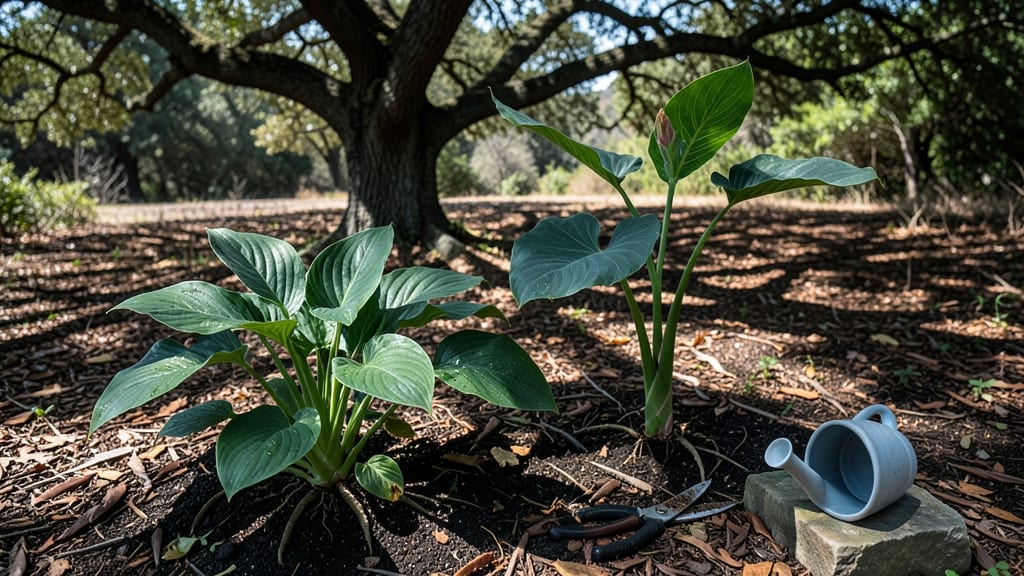
Canna lilies can grow in shade but thrive best in partial shade to full sun, with darker-leaved varieties tolerating lower light better than bright foliage types. Expect slower growth and fewer blooms in deep shade conditions.
Canna lilies adapt to shade, but their performance depends heavily on light intensity and leaf color. 🌿 Darker foliage varieties like 'Wyoming' handle low light better by producing more chlorophyll, while lighter-leaved types struggle to photosynthesize efficiently.
In partial shade, you'll still get blooms, though they may be smaller and less frequent than in full sun. The trade-off? Slower tuber development means fewer offsets for propagation over time.
For gardeners with shady spots, choosing the right cultivar makes all the difference. Varieties like 'Pactolus' or 'Durban' are proven performers in partial shade, maintaining vibrant foliage and occasional blooms even when sunlight is limited. Just be prepared to supplement with occasional fertilizing to support their reduced energy production.
💡 In This Article
- How Light Levels Affect Canna Lily Varieties
- Best Shade-Tolerant Canna Lily Varieties for Low-Light Gardens
How light levels affect canna lily varieties
Canna lilies rely on chlorophyll to convert sunlight into energy, and their leaf color directly impacts this process. Darker foliage varieties like 'Wyoming' (deep purple-black leaves) produce more chlorophyll cells per square inch, allowing them to photosynthesize efficiently even in partial shade (3-6 hours of direct sun daily).
This adaptation lets them grow taller stems and develop larger tubers despite lower light. In contrast, lighter-leaved types like 'Tropic Snow' (chartreuse foliage) struggle in shade because their reduced chlorophyll limits energy production. 🔥
The trade-off becomes clear when examining tuber development. In full sun, canna tubers store 20-30% more starch reserves annually, fueling rapid growth and frequent blooming.
Under deep shade (<3 hours of light), tubers shrink by 40-50% in size, leading to stunted plants that produce only 1-2 blooms per stalk instead of the usual 5-10. The plant's height also compresses—expect 3-4 feet in shade versus 5-6 feet in full sun.
This height reduction occurs because shade-starved plants allocate energy to leaf expansion rather than stem elongation.
Bloom frequency takes the biggest hit in low light. Canna lilies require 6-8 hours of sunlight to trigger the hormonal signals needed for flower bud formation. In partial shade, you'll see 30-50% fewer blooms, and the flowers themselves may be 20-30% smaller in diameter.
The color intensity also fades—deep reds become muted pinks, and yellows lose their vibrancy. For example, 'President Roosevelt' (red blooms) in shade might produce pale pink flowers that resemble 'Cleopatra' instead. 🌸
Leaf texture changes dramatically too. Shade-grown canna leaves develop a thicker, waxier coating to protect against UV damage from occasional sun exposure, while sun-grown leaves remain softer and more delicate.
This adaptation helps explain why shade varieties often have a slightly leathery feel when touched. The trade-off? These thicker leaves photosynthesize 15-20% less efficiently than sun-adapted foliage, further slowing growth.
For gardeners working with shade, understanding these adaptations helps set realistic expectations. While canna lilies won't die in low light, their performance becomes a delicate balance between survival and thriving.
Darker varieties can handle 30-40% less light than their bright counterparts, but even they require at least 3 hours of filtered sunlight daily to avoid chlorosis (yellowing leaves).
The key is matching the cultivar to your light conditions—'Pactolus' (red blooms) handles shade better than 'Striped' (yellow with red stripes), which needs more light to maintain its vibrant stripes.
Here's what's actually happening at the cellular level: Shade reduces the plant's ability to produce photosystem II proteins, which are critical for splitting water molecules during photosynthesis. This creates a photosynthesis bottleneck that forces the plant to prioritize leaf expansion over other functions like flowering.
The result? You get a lush foliage plant that looks healthy but produces minimal blooms—a classic case of source-sink imbalance where the plant can't allocate enough energy to reproductive growth. ✨