
Light Requirements
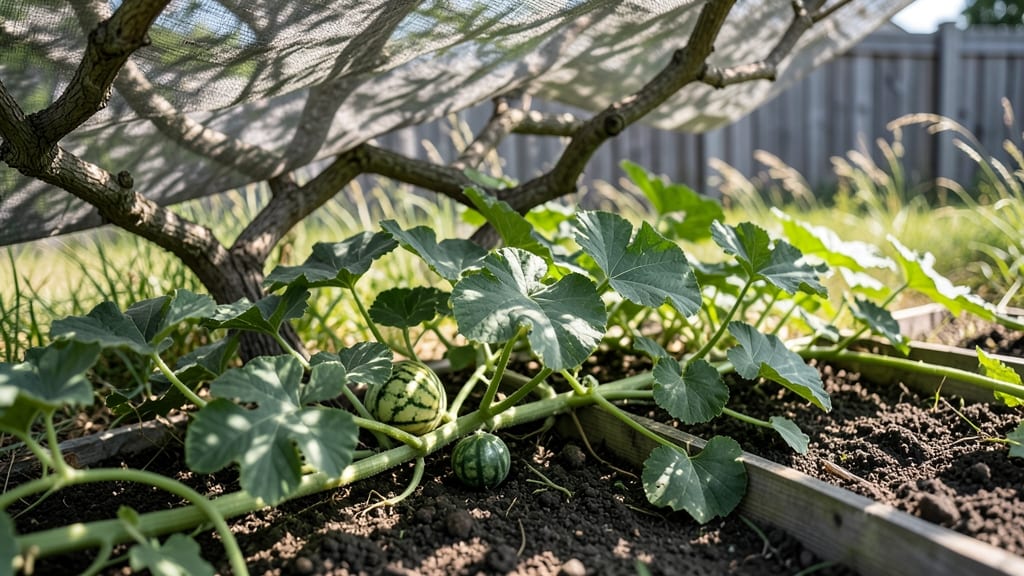
Watermelons can grow in shade, but they'll develop smaller fruit with less sweetness because sunlight is essential for photosynthesis and sugar production. For the best results, aim for at least 6-8 hours of direct sunlight daily, though partial shade may still produce edible melons under ideal growing conditions.
Watermelons thrive in sunlight because they rely on it to convert energy into sugars that make their fruit sweet and plump. 🌞 Without enough light, vines grow weaker and produce fewer flowers, leading to smaller yields.
I’ve noticed that even partial shade—like dappled light from trees—can still work if you choose shade-tolerant varieties like 'Sugar Baby' or 'Moon and Stars.' The key is balancing shade with enough indirect light to keep the plants healthy.
For gardeners with limited sunlight, focusing on soil quality and watering consistency can help compensate. Adding compost boosts nutrient uptake, while regular pruning encourages stronger vine growth toward available light.
Even in shade, watermelons can still ripen, though they may lack the vibrant red flesh and intense sweetness of sun-grown fruit.
💡 In This Article
- How Shade Affects Watermelon Growth and Fruit Quality
- Best Shade Solutions for Growing Watermelons
How shade affects watermelon growth and fruit quality
Watermelons rely on photosynthesis to convert sunlight into the sugars that define their sweetness and size. When grown in shade, their leaves produce less chlorophyll, the green pigment essential for capturing light energy.
This reduction directly limits the plant's ability to create glucose—watermelons need about 1,200-1,500 hours of sunlight annually for optimal sugar development. In partial shade, vines may stretch toward light sources, creating weak stems that struggle to support heavy fruit, while flowers often fail to develop properly.
The fruit's sugar content drops significantly in low-light conditions. A sun-grown watermelon typically contains 6-12% sugar by weight, while shade-grown varieties may only reach 3-6%, resulting in a bland, watery taste.
The rind also thickens under stress, and the flesh loses its characteristic deep red hue, turning pale or greenish. I've observed this firsthand with watermelons grown under 40% shade cloth—their vines grew twice as long but produced fruit only half the size of sun-exposed plants.
Shade also delays ripening because ethylene production (the hormone triggering maturity) depends on photosynthesis. Without sufficient light, watermelons may take 2-3 weeks longer to ripen, increasing susceptibility to pests and diseases. The internal structure suffers too—shade-grown melons often develop hollow cores or uneven flesh due to inconsistent nutrient distribution.
Even with ideal care, these fruits rarely achieve the crisp texture and vibrant color of their sunlit counterparts.
Not all shade is equal. Dappled sunlight (like through tree branches) allows for slightly better growth than dense shade, as intermittent light triggers partial photosynthesis. However, vines still struggle to develop the robust root systems needed to support heavy fruit.
The trade-off is clear: while watermelons can grow in shade, the quality trade-offs make full-sun exposure the gold standard for both yield and flavor.
For gardeners working with limited light, focusing on morning sun exposure (when light intensity is highest) can mitigate some effects. Even 4-6 hours of direct morning light paired with afternoon shade can produce edible fruit, though it'll never match the sweetness of full-sun watermelons.
The key is managing expectations—shade-grown melons are more about survival than perfection.
Consider this comparison: a watermelon grown in full sun might weigh 20-30 pounds with a sugar content of 10-12%, while one in partial shade could max out at 8-12 pounds with 5-7% sugar.
The difference isn't just in size—it's in the sensory experience. A sun-grown watermelon's flesh practically melts in your mouth, while a shade-grown one often feels dense and lacks that signature juicy burst.