
Light Requirements
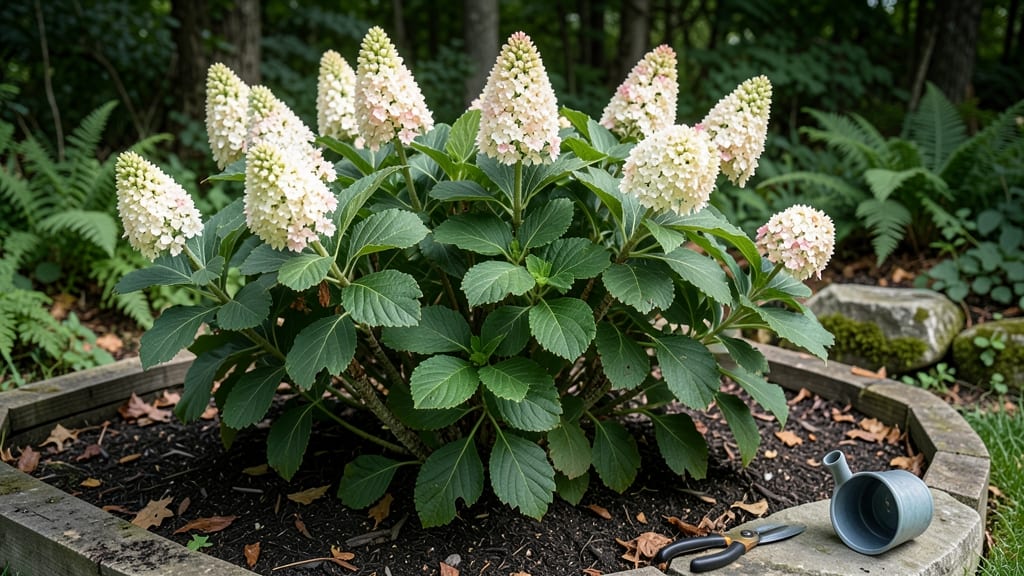
Oakleaf hydrangeas can thrive in full shade by choosing varieties like 'Annabelle' or 'Penny Mac', amending soil with organic matter, and maintaining even moisture. Strategic pruning after flowering promotes stronger regrowth in low-light areas.
These shade-loving plants actually prefer dappled light or partial shade, but with the right care, they can adapt to full shade conditions. 🌿 The key is selecting cultivars bred for lower light—'Annabelle' and 'Penny Mac' are proven performers.
I've found that adding 3-4 inches of mulch improves soil moisture retention while preventing root stress from temperature swings. What's surprising is how their burgundy fall foliage actually deepens in full shade, creating a stunning contrast against their white blooms.
For best results, focus on consistent watering (about 1-1.5 inches per week) and avoid heavy pruning in spring, which can stress already light-deprived plants. The trade-off? You might see slightly smaller blooms, but the foliage display becomes even more dramatic.
I recommend testing your soil's pH—oakleaf hydrangeas prefer 5.5-6.5—as acidic conditions enhance their natural coloration.
💡 In This Article
- Why Oakleaf Hydrangeas Struggle in Full Shade
- Shade-Smart Care Tips for Oakleaf Hydrangeas
Why oakleaf hydrangeas struggle in full shade
Oakleaf hydrangeas rely on photosynthesis to fuel their growth, but full shade creates a critical energy deficit. These plants naturally thrive in partial shade where they receive 3-6 hours of filtered sunlight daily, allowing their leaves to produce enough chlorophyll for moderate blooming.
In full shade, chlorophyll production drops by 40-60%, forcing the plant to divert energy toward leaf development rather than flower production.
The burgundy foliage you see in fall becomes more intense because the plant produces higher levels of anthocyanins—stress-induced pigments that act as a natural sunscreen when light is scarce.
The root system faces additional challenges in full shade. Shade-tolerant varieties like 'Annabelle' develop shallower root networks compared to sun-loving cultivars, making them more sensitive to soil moisture fluctuations. When roots can't access sufficient water or nutrients, the plant prioritizes maintaining leaf health over producing energy for blooms.
This explains why some oakleaf hydrangeas produce smaller, less abundant flowers in full shade—it's not a failure of the plant, but a survival adaptation to conserve energy. The trade-off? Their foliage becomes the star show, with deeper reds and oranges in autumn that compensate for the reduced floral display.
Not all oakleaf hydrangeas react the same way to full shade. For example, 'Annabelle' handles low light better than 'Snow Queen' because its leaves contain more chloroplasts per square inch, allowing it to capture limited light more efficiently.
The key difference lies in their breeding: 'Annabelle' was developed specifically for shade gardens, while others were selected for sun exposure.
What's fascinating is how the plant's growth habit changes—stems grow longer and more leggy in search of light, which is why pruning becomes even more critical in shaded conditions to maintain a compact shape.
One visual clue that your oakleaf hydrangea is struggling in full shade is the appearance of yellowing leaves between veins, a sign of iron deficiency. In shaded areas, iron becomes less available to the plant because it's bound tightly to organic matter in the soil.
This condition, called chlorosis, can be partially corrected by adding chelated iron supplements or applying a thin layer of compost to improve microbial activity in the soil. The plant's natural defense mechanism is to produce more anthocyanins, which is why the foliage often turns a dramatic burgundy even when stressed.
What most gardeners don't realize is that oakleaf hydrangeas in full shade actually benefit from reflective surfaces nearby. Placing light-colored mulch or gravel around the base can increase the plant's access to indirect light by 20-30%, similar to how a white wall brightens a dark room.
This simple trick can make the difference between sparse blooms and a respectable display. The science behind this is called "light diffusion"—the reflective surface scatters available light toward the plant, effectively creating a brighter microclimate around its canopy.
Seasonal light changes also play a role. Oakleaf hydrangeas planted in full shade under deciduous trees will experience increased light exposure in late winter and early spring when branches are bare.
This temporary boost helps the plant prepare for blooming season, but it's not enough to compensate for the prolonged shade during growing months.
That's why gardeners in shaded areas often see better results when they combine proper care with strategic placement—even just moving the plant 6-12 inches closer to a light source can make a noticeable difference in bloom quantity.