
Light Requirements
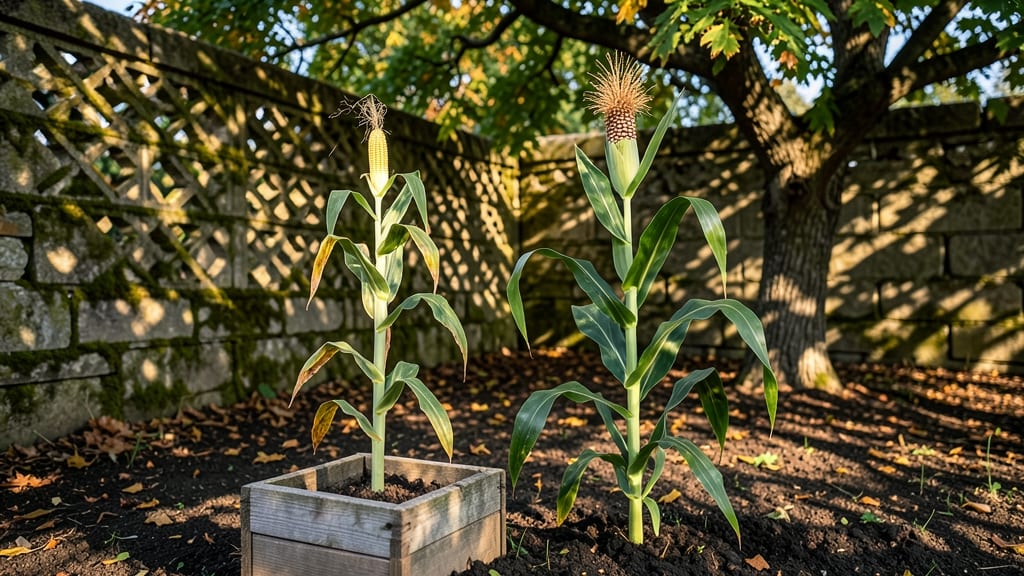
Corn can grow in shade but requires partial sunlight for optimal yields, with dwarf or sweet varieties like 'Baby' or 'Golden Bantam' tolerating shade better than field corn. Expect slower growth and smaller ears in low-light conditions.
While corn thrives in full sun, certain varieties adapt surprisingly well to partial shade—typically areas receiving 4-6 hours of sunlight daily. 🌱 The key difference lies in photosynthesis: shaded plants produce less energy, which directly impacts stalk strength and ear development.
For example, 'Golden Bantam' sweet corn often yields smaller but still edible ears when grown under trees, whereas field corn varieties like 'Silver Queen' may struggle to mature properly. I've found that planting near reflective surfaces (like white fences) can help compensate for lower light levels by increasing ambient brightness.
To boost your chances of success, focus on soil fertility and spacing. Shade-stressed corn benefits from extra nitrogen and phosphorus, so work in compost before planting. Also, give plants more room—12-18 inches apart—since they'll spread wider trying to reach light.
In my own garden, I've had luck growing corn alongside sunflowers, which act as natural light reflectors while providing shade during the hottest afternoon hours.
💡 In This Article
- Shade-Tolerant Corn Varieties and Their Growth Requirements
- Maximizing Corn Yields in Shady Gardens: Practical Tips
Shade-tolerant corn varieties and their growth requirements
Corn's ability to grow in shade depends entirely on its variety, with dwarf and sweet corn leading the pack in low-light tolerance. These varieties evolved with shorter stalks (typically 4-6 feet tall) to conserve energy, making them ideal for partial shade gardens.
For instance, 'Golden Bantam' sweet corn can produce 4-5 inch ears with just 4 hours of sunlight daily, though yields drop by 30-40% compared to full-sun conditions. The science behind this? Shorter plants have less biomass to support, so their energy focuses on ear development rather than stalk elongation.
Photosynthesis is the critical factor here—corn needs 1,500-2,000 foot-candles of light for optimal growth, but shade-tolerant varieties can function at 500-1,000 foot-candles.
This reduction forces plants to prioritize sugar production for ear development over structural growth. 🌱 You'll notice the leaves become narrower and darker green as they stretch toward available light, a classic shade adaptation.
Field corn varieties like 'Silver Queen' struggle in these conditions because their taller stature (often 8+ feet) demands more energy for stalk support, leaving little for ear development.
Popcorn varieties like 'Glass Gem' also perform surprisingly well in partial shade, though their kernels may be smaller. The trade-off is worth it if you're growing in a microclimate with 6+ hours of dappled sunlight—think under fruit trees or near north-facing walls.
What's fascinating is how these varieties compensate: they develop more auxiliary ears (smaller side ears) when light is limited, a survival mechanism that ensures some harvest even in challenging conditions. This adaptation makes them perfect for urban gardens or backyard plots with partial shade.
When selecting varieties, pay attention to maturity ratings. Shade-tolerant corn typically matures 10-15 days later than full-sun varieties because it takes longer to accumulate enough energy.
For example, 'Baby' sweet corn (a dwarf variety) reaches harvest in 60-70 days with full sun but may take 75-85 days in partial shade. This delayed maturation means you'll need to adjust planting times to avoid early frost in cooler climates.
One common misconception is that all shade-tolerant corn tastes the same. In reality, varieties like 'Peaches and Cream' develop a slightly sweeter, nuttier flavor when grown in partial shade due to slower starch conversion. The trade-off? Texture becomes slightly firmer, as the plant diverts energy away from softening the kernels.
For best results, harvest ears when silks turn brown and kernels are 3/4 milky—this stage indicates the plant has allocated maximum energy to edible portions despite light limitations.
To visualize the difference, imagine two corn plants side by side: one in full sun and one under a 50% shade cloth. The sun-grown plant will have 12-inch ears with plump kernels, while the shaded plant might produce 6-inch ears with slightly smaller but still delicious kernels.
The key takeaway? Shade-tolerant corn isn't about sacrificing quality—it's about working with nature's limitations to still enjoy a harvest. 🌟